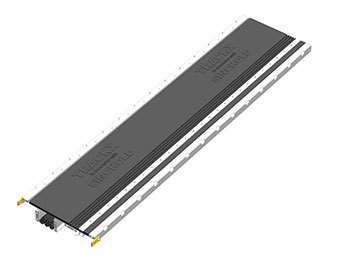
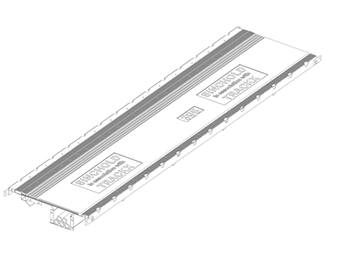
A crane rail system does more than provide a running surface for an overhead crane. It transfers wheel loads into the supporting structure, controls rail position, absorbs vibration, and maintains alignment under repeated loading. When the rail is installed directly on a rigid steel or concrete support without an appropriate interface layer, impact and vibration can be transferred more directly into the structure. Over time, this may contribute to rail wear, fastener loosening, local deformation, and maintenance problems.
A soft mounted crane rail system uses an elastic or resilient layer between the crane rail and its supporting structure. Depending on the project, the system may combine rail pads, clamps, soleplates, bolts, leveling components, and other fastening elements. The purpose is not simply to make the rail installation “softer.” The system must provide controlled elasticity while maintaining sufficient lateral and vertical restraint.
For crane operators, engineering contractors, EPC companies, and rail system distributors, understanding how this type of fastening arrangement works is important when selecting components for industrial facilities, workshops, ports, steel plants, warehouses, power plants, and other heavy-duty environments.
What Is a Soft Mounted Crane Rail System?
A soft mounted crane rail system is a crane rail fastening arrangement in which an elastic layer or resilient component is positioned between the rail and its supporting structure.
The basic load path can be understood as:
Crane wheel → rail → rail pad or resilient interface → fastening assembly → supporting structure
The rail pad is typically manufactured from an elastomeric or other resilient material selected according to the project requirements. Depending on the design, additional components may include:
The exact configuration varies according to rail type, crane capacity, support structure, wheel loads, rail profile, installation method, and operating environment.
The important point is that the resilient layer does not replace mechanical fastening. The rail still needs to be securely restrained against vertical and lateral movement. The elastic interface works together with the fastening components to create a controlled connection between the rail and the supporting structure.
Why Use a Soft Mounted Crane Rail System?
Crane rails are exposed to repeated dynamic loading. The actual load experienced by the rail is not limited to the static weight of the crane and its lifted load. Acceleration, braking, wheel passage, load distribution, rail alignment, and operating conditions can all affect the forces transferred through the rail system.
A resilient mounting arrangement can help manage some of these effects.
Vibration Control
When crane wheels pass over a rail, the contact between wheel and rail generates vibration. Rail joints, alignment deviations, surface irregularities, and crane acceleration can increase dynamic effects.
A resilient rail pad provides an interface that can reduce direct transmission of vibration from the rail into the supporting steelwork or concrete structure.
This can be particularly relevant in facilities where cranes operate frequently or where structural vibration needs to be controlled.
However, the rail pad should not be considered a universal vibration solution. Its performance depends on material properties, thickness, hardness, compression characteristics, fastening pressure, rail load, and the overall support structure.
Load Distribution
A steel crane rail has a relatively small contact area compared with the supporting beam or concrete foundation. A properly selected resilient layer can help distribute the contact pressure between the rail and support.
This is one reason rail pads are commonly considered when engineers are developing a complete fastening arrangement rather than simply bolting the rail directly to a structural member.
The pad must remain within its intended compression range. Excessive compression can reduce its ability to accommodate movement and may cause premature material deformation.
Compensation for Minor Surface Irregularities
Steel structures and concrete foundations are not always perfectly uniform. Fabrication tolerances, welding deformation, surface unevenness, and installation deviations can create small variations in the support surface.
A suitable rail pad can accommodate certain minor irregularities and help establish more consistent contact between the rail assembly and its support.
This does not mean that a soft mounted system can compensate for poor civil or steelwork construction. Significant elevation or alignment errors should be corrected during installation rather than relying on the pad to absorb them.
Reduced Metal-to-Metal Contact
When a rail is mounted directly on a steel support, there may be extensive rigid contact between the rail base and the supporting member. Introducing a resilient interface changes the mechanical behavior of the connection.
The resulting assembly can provide a more controlled transition between the rail and support while also reducing direct metal-to-metal contact.
Main Components of a Soft Mounted Crane Rail System
A reliable crane rail installation is normally a system rather than a single product. Each component has a specific function.
Crane Rail
The rail provides the running surface for the crane wheels. Rail profile, dimensions, material grade, straightness, and surface condition must be compatible with the crane design and operating requirements.
The correct rail should be selected according to wheel load, crane capacity, wheel diameter, rail span, operating frequency, and supporting structure.
A rail profile should never be selected based only on nominal crane capacity. Wheel loads and actual operating conditions are important inputs.
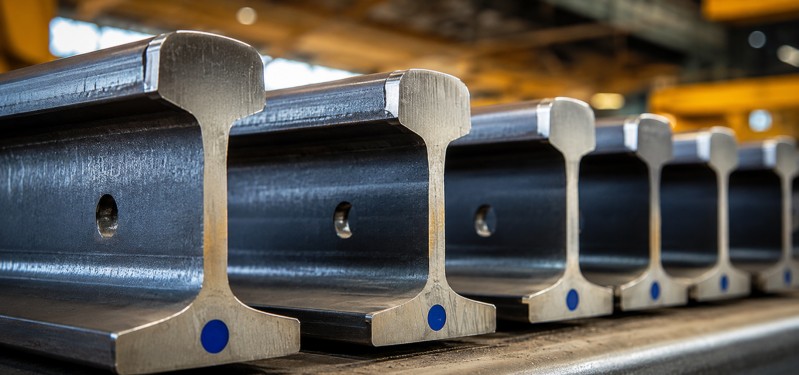
For projects requiring new rail supply, Sinchold provides steel rail products as part of its broader rail system portfolio.
Rubber or Resilient Rail Pad
The rail pad is one of the defining components of a soft mounted crane rail system.
Its material and dimensions should be selected according to the expected load and environmental conditions. Important parameters may include:
The correct material depends on the application. A crane operating in a clean indoor warehouse may have very different environmental requirements from a crane used in a steel mill, port, chemical plant, or outdoor industrial yard.
Crane Rail Clamps
Rail clamps hold the rail in position while allowing the fastening arrangement to accommodate the required degree of movement.
Clamp geometry must match the rail profile and the supporting arrangement. The clamp should provide sufficient restraint without creating excessive local stress on the rail.
A common installation error is treating rail clamps as generic hardware. In reality, clamp dimensions, contact surfaces, bolt positions, and tightening requirements should be considered together with the rail and support structure.
Soleplates
Soleplates can be used between the rail assembly and the supporting structure when the project requires a rigid load-spreading component.
A soleplate may help distribute loads, establish a suitable mounting surface, and simplify installation. When combined with an elastic pad, the overall system can provide both load distribution and resilient separation.
The appropriate configuration depends on whether the support is a crane runway beam, concrete foundation, embedded structure, or another type of structural base.
Bolts and Fastening Hardware
Bolts, nuts, washers, and related components complete the mechanical connection.
Fastener selection should account for the required preload, environmental exposure, access for installation, corrosion protection, and maintenance requirements.
The bolt should not be selected independently of the clamp. The entire fastening assembly must work together to provide the required restraint.
Soft Mounting vs. Rigid Rail Mounting
The choice between a resilient and rigid mounting arrangement depends on the application rather than on a universal rule.
A rigid mounting arrangement may be appropriate where the engineering design calls for direct structural connection and where vibration isolation is not a major consideration.
A soft mounted crane rail system may be considered when the project requires an elastic interface to manage vibration, accommodate minor surface variation, or modify the load transfer characteristics between the rail and support.
The comparison should therefore focus on engineering requirements rather than simply asking which system is “better.”
Key factors include:
| Design Factor | Rigid Mounting | Soft Mounted System |
|---|
| Rail-to-support interface | Direct or rigid | Includes resilient layer |
| Vibration transmission | More direct | Can be reduced depending on design |
| Surface tolerance | More dependent on support accuracy | Pad can accommodate limited irregularities |
| Load distribution | Depends on support geometry | Can be improved through suitable pad design |
| Maintenance | Depends on fastening design | Requires inspection of pad condition as well |
| Installation | Often requires precise support preparation | Requires correct pad and clamp installation |
| Dynamic behavior | More rigid | More elastic |
The actual performance of either arrangement depends on engineering design, installation quality, and operating conditions.
How to Select a Soft Mounted Crane Rail System
Selecting a system should begin with the crane and support structure rather than the fastening components.
1. Determine the Wheel Load
Wheel load is one of the most important inputs.
The engineering team should consider:
The maximum wheel load should be used to establish the required capacity of the rail and fastening assembly.
A rail pad that appears suitable based on static load alone may not be appropriate under repeated dynamic loading.
2. Identify the Rail Profile
The fastening system must match the selected rail profile.
Rail base width, rail height, head geometry, and base configuration affect clamp design and pad dimensions.
Using a generic clamp on an incompatible rail profile can result in poor contact, insufficient restraint, or excessive local stress.
3. Evaluate the Supporting Structure
The support may consist of:
Steel runway beams
Reinforced concrete
Embedded steel plates
Concrete foundations
Fabricated crane girders
Other structural members
The support surface should be checked for flatness, alignment, elevation, strength, and condition before installation.
The fastening system should be designed around the actual support structure rather than forcing an existing fastening product into an unsuitable installation condition.
4. Consider Operating Frequency
A crane used occasionally for light material handling has different requirements from a crane operating continuously in a production facility.
High-frequency operation means the rail and fastening system will experience a large number of loading cycles.
Fatigue, fastener loosening, rail wear, pad compression, and alignment stability therefore become increasingly important.
5. Consider the Environment
Environmental conditions can have a direct effect on both metal and polymer components.
For example, the project may involve:
The rail pad and fastening hardware should be selected for the actual environment rather than based only on standard indoor conditions.
6. Establish Installation Tolerances
Before ordering components, the project team should define the required rail elevation and alignment tolerances.
The fastening system should not be expected to correct major structural errors.
Where significant deviations exist, appropriate leveling plates, shims, grout, or structural corrections may be required.
Installation Procedure for a Soft Mounted Crane Rail System
Correct installation is essential because even a well-designed fastening system can perform poorly if installed incorrectly.
Step 1: Inspect the Support
Check the crane runway or foundation before placing the rail.
Verify:
Support dimensions
Surface condition
Elevation
Straightness
Rail centerline
Bolt or fixing locations
Welded components
Embedded plates
Cleanliness
Any significant defects should be corrected before rail installation begins.
Step 2: Position the Rail Pad
Place the resilient pad continuously or according to the approved system design.
The pad should be correctly aligned with the rail base. It should not be folded, excessively stretched, contaminated, or damaged.
Where joints between pad sections are required, the joint arrangement should follow the installation specification.
Step 3: Position the Rail
Place the rail on the pad and establish the required horizontal and vertical alignment.
At this stage, installers should check the rail centerline, elevation, rail gauge where applicable, and transition between rail sections.
The rail should not be forced into alignment by excessive clamp pressure.
Step 4: Install Clamps
Install the crane rail clamps according to the specified spacing and orientation.
Clamp spacing should be determined by the engineering design and operating loads. The correct spacing depends on the rail section, support condition, wheel load, and fastening system.
Step 5: Tighten Fasteners
Fasteners should be tightened using the specified method and torque or preload requirements.
Over-tightening can compress or damage the resilient pad and may alter the intended mechanical behavior of the system.
Under-tightening can allow unwanted rail movement.
For critical crane runway systems, controlled tightening and documented installation procedures are preferable to relying on manual judgment alone.
Step 6: Check Rail Alignment
After the initial fastening, check the rail again.
Typical checks include:
Rail elevation
Horizontal alignment
Rail straightness
Joint condition
Clamp position
Fastener condition
Pad position
Rail spacing
Any deviation should be corrected before the crane enters service.
Step 7: Conduct Final Inspection
A final inspection should confirm that the complete fastening assembly corresponds to the approved installation design.
For major projects, the installation record may include photographs, measurement results, fastener torque records, material certificates, and inspection documentation.
Common Problems in Crane Rail Installation
Many crane rail problems are not caused by the rail itself. They result from the interaction between the rail, support structure, fastening system, and installation process.
Uneven Rail Support
If the rail pad does not sit evenly on the supporting surface, the rail may experience localized loading.
The solution is not simply to increase fastener torque. The underlying support condition should be corrected.
Incorrect Clamp Spacing
Excessive spacing can reduce rail restraint and increase local rail movement.
Very close spacing, on the other hand, may increase installation cost and may not provide proportional performance benefits.
Clamp spacing should therefore be established through engineering calculations and project requirements.
Excessive Fastener Tightening
A resilient mounting system depends on controlled compression.
If bolts are tightened excessively, the pad may be compressed beyond its intended working range. This can affect elasticity and long-term performance.
Poor Rail Alignment
Even a high-quality fastening system cannot compensate indefinitely for an incorrectly aligned runway.
Poor alignment can increase wheel and rail wear, produce additional noise and vibration, and affect crane operation.
Rail alignment should therefore be checked during installation and periodically during service.
Incompatible Components
Using a rail clamp, pad, bolt, or soleplate without checking compatibility can create problems.
For example, a pad designed for one rail base width may not provide appropriate coverage for another profile. Similarly, a clamp intended for one rail section may not provide the required contact on another.
A complete system approach is preferable.
Maintenance of a Soft Mounted Crane Rail System
A crane rail fastening system should be inspected as part of the overall crane runway maintenance program.
Inspection frequency should reflect the crane's operating conditions, load spectrum, environment, and applicable engineering or safety requirements.
Inspect Rail Condition
Look for:
Rail head wear
Surface defects
Cracks
Local deformation
Abnormal wheel marks
Joint deterioration
Corrosion
Unusual rail wear may indicate problems elsewhere in the runway system.
Inspect Clamps and Bolts
Check for:
A loose clamp should not simply be retightened without checking why it became loose.
Inspect the Rail Pad
The resilient pad should be checked for:
Permanent compression
Cracking
Splitting
Hardening
Extrusion
Chemical degradation
Loss of thickness
Displacement
Pad deterioration can change the load-transfer characteristics of the rail fastening system.
Monitor Rail Alignment
Periodic alignment measurement can help identify gradual movement before it becomes a major maintenance issue.
The appropriate measurement method depends on the project. Surveying, laser measurement, mechanical gauges, and other inspection techniques may be used.
Where Soft Mounted Crane Rail Systems Are Commonly Considered
Resilient rail mounting can be relevant in many industrial applications.
Steel Plants
Steel mills often involve high crane utilization, heavy wheel loads, elevated temperatures, and demanding production environments.
The fastening system must be selected with these conditions in mind, including material resistance and maintenance accessibility.
Ports and Container Terminals
Cranes operating in ports may be exposed to moisture, salt, wind, and continuous operating cycles.
Corrosion protection and inspection accessibility become important considerations.
Manufacturing Facilities
Large manufacturing plants may use overhead cranes to move dies, molds, steel components, machinery, or other heavy products.
In these facilities, vibration and structural interaction can be important factors when selecting the rail mounting arrangement.
Warehouses and Logistics Buildings
Warehouse cranes may operate at relatively high frequencies. Rail alignment and smooth crane travel can directly affect operational efficiency.
The fastening system should be matched to the actual crane duty rather than selected solely according to the building type.
Power and Energy Facilities
Power plants and other energy facilities may contain heavy-duty cranes for equipment installation and maintenance.
Depending on the location, the rail system may need to withstand temperature variation, oil exposure, dust, or other environmental conditions.
When a Soft Mounted System May Not Be Appropriate
A resilient interface is not automatically the right choice for every crane rail project.
A project may require a different fastening configuration because of:
Structural design constraints
Required rail stiffness
Extreme wheel loads
Special temperature conditions
Limited installation space
Existing embedded components
Specific crane manufacturer's requirements
Applicable engineering standards
Existing runway geometry
The decision should be made from the complete engineering requirements.
For replacement projects, the existing rail, support beam, clamps, pads, and structural condition should be inspected before selecting replacement components.
Soft Mounted Crane Rail System for New Projects
For a new crane runway, the fastening system should be considered during the design stage rather than added after the supporting structure has already been fabricated.
Early coordination allows engineers to establish:
Rail profile
Wheel loads
Support dimensions
Pad requirements
Clamp type
Fastener arrangement
Installation tolerances
Rail alignment requirements
Drainage and environmental considerations
Inspection and maintenance access
This approach can reduce field modifications and help ensure that the rail, fastening components, and supporting structure are compatible.
For EPC contractors and distributors, having these parameters available at the quotation stage also makes technical communication with the manufacturer more efficient.
What B2B Buyers Should Ask a Rail System Supplier
When sourcing a soft mounted crane rail system, purchasing teams should request more than a product catalog.
Useful technical questions include:
Which rail profiles can the system accommodate?
What rail pad materials are available?
What are the pad dimensions and thicknesses?
What are the relevant mechanical properties?
What clamp types are available?
What clamp spacing is recommended?
What fastener specifications are required?
What installation tolerances should be maintained?
Is the system suitable for outdoor applications?
What temperature range is supported?
How should the pad be inspected during service?
Are replacement pads and fastening components available?
Can the supplier provide engineering drawings?
Can components be customized for a specific rail profile?
What quality inspection documents are available?
Can the supplier support installation or commissioning?
These questions help move procurement away from comparing individual hardware items and toward evaluating the complete rail fastening solution.
Why System Compatibility Matters
A crane rail system should be viewed as an assembly.
The rail determines the running interface. The pad affects the resilient connection. The clamp provides restraint. The bolt provides the mechanical connection. The soleplate may distribute load and establish the mounting surface. Grouting or leveling materials may be required to correct or stabilize the support condition.
Changing one component can affect the performance of the others.
For example, changing the rail profile may require a different clamp. Changing pad thickness may affect rail elevation. Changing the support arrangement may require a different soleplate or fixing method.
This is why B2B buyers should provide technical information to the supplier before selecting individual components.
Integrating Rail Installation and Fastening Supply
For large infrastructure and industrial projects, purchasing rail and fastening components separately can create coordination issues.
An integrated rail supplier can support several stages of the project, including:
Rail selection
Fastening system design
Rail clamps
Soleplates
Rubber pads
Bolts and accessories
Grouting materials
Rail welding
Installation
Maintenance support
This approach can simplify technical communication because rail dimensions, fastening components, and installation requirements can be considered together.
Sinchold operates as an integrated rail systems manufacturer and solution provider, covering rail fastening products, steel rails, and rail installation services. Its product range includes railway spring bars, turnout systems, track fastener combinations, crane track clamps, track cleats, fish plates, bolts, coking track fixing systems, and steel rails, together with rail welding and grouting services.
Practical Checklist Before Ordering
Before requesting a quotation for a soft mounted crane rail installation, prepare the following information where available:
Project information
Project location
New installation or replacement
Indoor or outdoor application
Operating environment
Expected installation schedule
Crane information
Rail information
Rail profile
Rail length
Required quantity
Existing or new rail
Rail joint arrangement
Support information
Fastening information
Providing these details at the beginning allows a manufacturer to evaluate the application more accurately and reduce unnecessary technical revisions during procurement.
Final Considerations
A soft mounted crane rail system should not be treated as simply a crane rail combined with a rubber strip. Its performance depends on the interaction of the rail, resilient pad, clamps, fasteners, support structure, installation tolerances, and operating conditions.
For B2B projects, the most important considerations are usually wheel load, rail profile, support structure, operating duty, environmental conditions, fastening arrangement, and installation quality. The resilient layer should be selected based on its actual working conditions, while the complete fastening assembly should be checked for compatibility.
A properly engineered system can provide a controlled connection between the crane rail and its support while addressing vibration, load distribution, alignment, and maintenance requirements. At the same time, no fastening system can compensate for an inadequately designed runway or poor installation practice.
For distributors, contractors, EPC companies, and industrial end users, the most efficient procurement process is to provide the supplier with complete technical information and evaluate the rail, clamps, pads, soleplates, fasteners, and installation requirements as one system.
Sinchold combines rail fastening manufacturing, steel rail supply, and rail installation capabilities to support projects that require coordinated rail system components. For crane runway projects, the appropriate configuration can be developed according to the rail profile, load requirements, support structure, operating environment, and installation conditions.
 中文
中文 English
 Россия
 Deutsch
 Français
 Español
 Português
 العربية










 Sinchold
 Sep 16 2026
 Sinchold


 Recommended news